Showing posts with label containment. Show all posts

Tuesday, March 19, 2013

On Fukushima: I told you so!


On March 30, 2012 I wrote a blog entry entitled “Review of Fukushima Daiichi Nuclear Disaster”.  In this entry, I briefly discussed the necessity of providing adequate venting to prevent the escape of radioactive waste to the outside in the event of loss of power and a resulting explosion.  Here is what I wrote:

Venting channels to help relieve the high pressures resulting from any explosion inside the reactor are readily provided in a domed containment structure. These vents are typically filled with boron-based sand or aggregate, and activated carbon. This sand, aggregate and activated carbon remove radioactive material from explosive gasses as they pass through the venting channel, before they vent to the outside atmosphere.”

In response to this entry, some anonymous source posted the following remark on May 2, 2012:

Containment is supposed to be virtually leak-tight under all Design Basis conditions. Venting Channels defeat this purpose.”

I replied on May 2, 2012:

“It is impossible to contain a supersonic explosion without venting, or else the containment structure becomes a "bomb". See this discussion by Arnie Gunderson of Fairewinds. Evidence seems to indicate "inadvertent criticality" as cause of explosion. In order to begin to control the effects of such an explosion venting is required. http://www.youtube.com/watch?v=vs53iOn2K2w

The same anonymous source then replied once more, also on May 2, 2012:

“An explosion is beyond Design Basis except for Steam Generator Faults and LOCAs. These are supposed to be complely contained within containment. Any explosion such as "inadvertent re-criticality" is not containable without loss of containment integrity.”

At this point, I realized that due to the language used, the defensive posturing, and the inability to admit a design flaw in an inherently flawed design; that I was most likely communicating with an engineer or Public Relations employee from General Electric (GE).  The nuclear reactors involved in the Fukushima Daiich disaster are GE Mark I reactors.  There are currently 31 reactors very similar to those at Fukushima Daiichi in the US. 

In an effort to be clear, to emphasize a solution, and, furthermore, in an attempt not to antagonize or further alienate this anonymous commenter, I offered the following, final remark in our exchange (also on May 2, 2012):

“The containment structure is not adequate to contain an explosion without venting. (I think we are saying the same thing?) As proven by experience, explosions happen at nuclear reactors. The containment structure should be designed to withstand an explosion, this necessitates inclusion of proper venting. The existing structures at Fukushima were improperly designed and built. They need to be fixed, they need better containment (with venting) since explosions can and do happen.”

My hapless anonymous commenter did not respond.
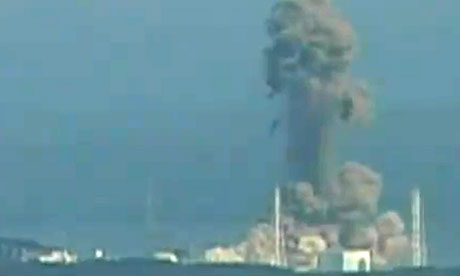
 

Today, March 19, 2013, The US Nuclear Regulatory Commission (USNRC) posted an entry on their blog, entitled “NRC Commission Approves More Post-Fukushima Upgrades to Nuclear Plants.”  In this blog entry, the NRC demands strengthened venting at the 31 nuclear reactors in the US which are similar to the GE reactors involved in the disaster at Fukushima Daiichi.

Quoting from today’s USNRC blog entry (3/18/13):

“The venting systems at Fukushima played a role in their nuclear crisis, and the NRC issued an Order to the 31 plants with similar designs to take action. The plants either had to install vents or improve their existing venting system. The goal was to make sure the vents can operate during the early phases of an accident, even if the plant lost all power for an extended time.

In their latest decision, the NRC Commission votes to further strengthen these vents. The NRC staff has 60 days to finalize an Order for these enhancements. Generally speaking, these additional requirements mean the vents could handle the pressures, temperatures and radiation levels from a damaged reactor, and that plant personnel could operate the vents under these conditions.

As part of the same decision, the Commissioners directed the staff to begin a formal rulemaking on filtering methods that would prevent radioactive material from escaping containment in an accident, either through new filter systems or a combination of existing systems. The staff will develop the technical analysis, a proposed rule and then a final rule. Throughout this process, the public and various stakeholders will have opportunities to submit comments and attend meetings to ask questions. And there will be many future posts about the progress!”

To my anonymous commenter:  I told you so!

Luckily, there has not been a nuclear disaster in the US since the March 11, 2011 tsunami disaster in Japan.  Hopefully there will not be a disaster before proper venting is provided to the 31 nuclear reactors in the US which are inherently flawed and pose a significant risk in the meantime.  If any nuclear reactor operators are seeking an effective, affordable solution to this engineering challenge, I urge you to contact me.  I was right when I posted on March 30, 2012; I am right now. 

Wednesday, November 28, 2012

Radioactive trowels and robots

Today there was an interesting item on the US Nuclear Regulatory Commission's blog about a radioactive trowel.  Here's the item, about how the president almost handled a radioactive trowel:

Uncovering the real story of Joe Ball's trowel required research at the Department of Energy's archives, where I could get more information about the AEC’s move from Washington, D.C., to Germantown, Md., in 1957. The AEC's move was precipitated by the Soviet Union development of thermonuclear weapons. To survive a 20 megaton blast over the capital mall, AEC offices needed to be at least 20 miles away. Germantown was selected over 50 other sites.
This Cold-War move coincided with new initiatives by the AEC to promote civilian nuclear power plant construction. Thus, the dedication ceremony became a chance to highlight the atom's contribution to national defense and its potential peaceful applications.
The AEC created a ceremony heavy in symbolism. Electricity from batteries charged by eight military and civilian power reactors lifted a curtain on a commemorative plaque in the new building lobby. A time capsule was placed behind the cornerstone packed with military and civilian artifacts, such as pictures of the Nautilus and scraps of linen wrappings for the Dead Sea scrolls dated by radiocarbon techniques.
As I found out from the DOE archives, AEC Chairman Lewis Strauss wanted even more symbols for the dedication ceremony. He asked for a trowel with some historical significance and Argonne National Laboratory obliged, including, as mentioned in Part I, creating a blade made from uranium. AEC officials liked the trowel and planned on giving speeches about its symbolism to local groups.
But there was a problem.
The uranium metal had been reused for many years in other experimental reactors, most likely in the CP-2. The uranium was still radioactive, enough that an Argonne official told the AEC to use only the handle and not touch the blade. Hoping to preclude objections from the White House, the AEC medical staff reassured the Secret Service that the trowel was a “unique opportunity” for Eisenhower “to demonstrate under completely safe conditions the proper way to perform an operation involving radioactive material.”
AEC assurances didn't work. Ike's staff refused to allow the president to touch anything radioactive. Stymied, the AEC substituted three silver-plated trowels. The uranium trowel was dropped from the ceremony and the silver-plated trowels that history records were used instead. The fate of the symbolic trowels – of which there were either two or three – were mostly lost to history, with one spending decades in storage at Eisenhower College's old campus.
Joe Ball's unusual auction win find reminds us why we love artifacts—their stories are fun. They teach us about the society that made them. The CP-1 trowel was born out of an optimism in the possibilities of the atomic age, but even in the 1950s radiation concerns proved powerful. Today most people likely sympathize with the White House's fear of radiation, and the trowel probably seems like a questionable use of radioactive material.
And so Argonne's creation reminds us how the nation had changed in the last half century in shifting to a more sober attitude toward nuclear hazards.
Joe Ball has graciously agreed to loan the trowel to the NRC , where it is now displayed in our lobby.
Tom Wellock
NRC Historian

Also today, an item in the news about Chernobyl's new containment structure coming closer to being completed. 
 
 
It seems to me that robots should be the only ones handling radioactive trowels.  
 

Friday, March 30, 2012

Review of Fukushima Daiichi nuclear disaster

Previously on this blog I’ve written about the nuclear disaster at Fukushima Daiichi which occurred following the earthquake and tsunami on 3/11/11; here, here and here.  Just as the US has its 9/11 tragedy, so too Japan has its 3/11 tragedy. 
 
I proposed a solution for containment and protection of the nuclear reactors at Fukushima based on a masonry system used to construct containment/protection domes around these damaged reactors.  There are many advantages to this system over competing approaches.  Today (3/30/12) a new report has been issued which outlines some of the hazards and inherent dangers present at Fukushima and their continuing threat.
As I said earlier, this danger will exist for a very long time to come.  The press has previously reported (12/11) that the Fukushima site is stabilized and that any danger or threat from these damaged reactors is essentially under control.  As today’s report shows, this danger is not stabilized and the threat from these damaged reactors remains high, and will remain high for a very long time (just like I said earlier).

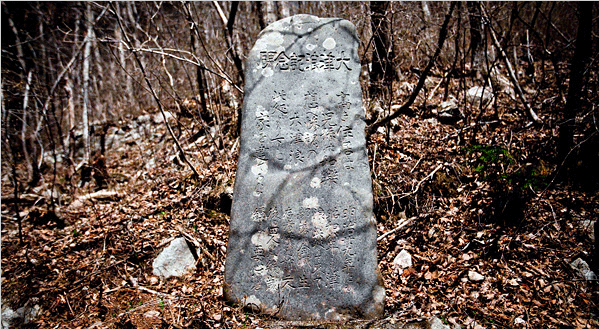
Tokyo Electric Power (Tepco) has seriously mishandled this situation since before it began.  They disregarded Japan’s own history of previous tsunamis, even though gigantic stone markers ("tsunami stones") were left in the area, hundreds of years ago, warning inhabitants:  “DO NOT BUILD HERE.”  The refusal of Tepco to acknowledge the extremely dangerous conditions at Fukushima for months after the accident further illustrate the poor management at Tepco.  Japanese society and culture place a high value on honor and integrity, yet Tepco has acted with a lack of honor and integrity throughout this crisis.  As I wrote in an earlier entry, Tepco was at one point trying to stuff the cracks in its poorly made containment structures with wet newspaper and diaper material.  Wet newspaper and diapers to control lethal radiation!
With today’s report on the state of the Fukushima’s damaged nuclear reactors, I am revisiting this topic.  My previous blog entries on Fukushima have been viewed over 5,000 times.  I wonder if anyone from Tepco, or Japan, or Westinghouse, or General Electric has read these entries?   At one point I was approached by a western consortium that had put together a comprehensive plan for clean-up and relief of Japan following the tsunami.  They asked to use my system.  Nothing ever came of it: the principals said Japan is seeking to fix its own problems largely on its own.  In terms of making Fukushima safe, they have not done so.  There is much to be done before Fukushima is stable, or safe, or manageable over a long time frame.
With today’s entry I am attempting to remind any reader that the masonry system described in this blog could be an effective, affordable, manageable method to help increase the safety at Fukushima for a very long time.
The advantages of the masonry system I propose are outlined here in summary form:
·         Mass production of the interlocking triangular masonry units allows them to be made as an engineered system at low cost, in high volume, in a short time, using existing concrete block manufacturing equipment.  The infrastructure to produce this system already exists.

·         Use of Boron-based material in the concrete mix will act to absorb radiation.  This is an existing practice in the nuclear industry; it is a known and established material and method to help control radiation.

·         Use of concentric shells in a dome structure will greatly increase the safety factor of the domed structure.  Additional layers, or wythes of brick are easy to add, and increase the safety with each subsequent layer of block.

·         The articulated shape of the masonry unit makes it inherently easy for robotic assembly.  Multiple contact guiding surfaces align the block, and allow them to simply slide together where they are effectively locked into position.

·         A spherical dome is the strongest and most robust configuration possible for this application.  In terms of an exterior applied force, is stronger than a catenary arch, and will act not only as a containment structure, but will also protect the reactors from any other tsunamis, typhoons, terror attacks and the like.

·         I have developed an automated method for placing mortar between blocks in a dome.  This would be very easy to do robotically (this method is not described here, it’s proprietary).

·         Producing masonry units at a manufacturing plant allows Quality Control which is simply not possible if wet concrete is poured on-site at a radioactive, damaged reactor facility.  As an example of poor QC, see the current state of the sarcophagus at Chernobyl.  There are now holes in it large enough to drive a car through.

·         Venting channels to help relieve the high pressures resulting from any explosion inside the reactor are readily provided in a domed containment structure.  These vents are typically filled with boron-based sand or aggregate, and activated carbon.  This sand, aggregate and activated carbon remove radioactive material from explosive gasses as they pass through the venting channel, before they vent to the outside atmosphere.

If anyone reading this is working on fixing the situation at Fukushima (or knows people who are) I urge you to contact me.  There is much more to this system than what I have described here.  I am eager to help if I can in any way.  Please feel free to contact me.