Showing posts with label gothic. Show all posts

Monday, April 5, 2010

Gothic Arches: pointing to the future?

So...  I've developed triangular blocks to build cylinders.  They can also be used to make arches.  How can arches be made to sit on square-cornered structures, if those arches are made from triangular block?

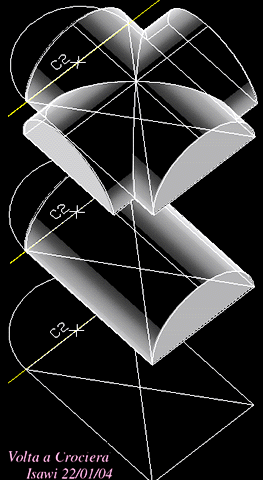
Describing geometry with words is very difficult, as anyone who's bothered to read this blog can probably attest!  Sorry folks, but it's a challenge!  Today I'll look at lots of images to try and give the reader some familiarity with this subject.  They're also very cool to look at.  This is the sort of thing I want to be able to do with manufactured block.

Here's one example of arches at right angles to each other.  Note the diagonal ribs.

Here's another example of arches at right angles to each other.  Note how they rest on pillars.  I can do this too with my masonry system.  This would make for a pretty cool house!

Here are sketches of a ribbed vault and a gothic vault.  My system is something of a hybrid between these two.


Here is another example of arches at 90 degrees to each other.  Again, note the diagonal ribs.


Yet another example of arches at right angles to each other.  This is romanesque.

Here's a schematic showing two arches (barrel vaults) intersecting at right angles to each other.
Here's a free body diagram showing stress analysis of individual masonry units in an arch, known as "voussoirs."  It is better to have short "block-like" segments instead of long skinny ones.


Having shown some images of arches meeting at right angles, tomorrow we'll see how this problem is essentially the ancient problem of "squaring a circle" and we'll look at what exactly that means.  Below is an ancient image of this problem.  I love how it's drawn on a brick wall, which is the specific realm we're looking at.

Wednesday, March 17, 2010

St Patrick, Mason

(re-posting on this special day!)

Mediterranean architecture had a long history of masonry construction at the advent of Christianity as a religion. Typical Mediterranean masonry architecture included domed roofs, arches and thick stone walls.

With the gradual collapse of the Roman Empire and the spread of Christianity, evangelists brought their masonry construction techniques (as well as scripture) to northern Europe. Initially these construction techniques dominated as Romanesque architecture. This architectural style is characterized by round arches, thick walls, and generally stolid (unmovable, dull) and squat configurations; typically described as "over-engineered" and using a surplus of material, or "more than is needed."

Romanesque architecture endured and flourished across northern Europe for centuries. The existence of this architecture today is a testament to its high strength and robust design.

One of the unique evangelists who spread the gospel was St. Patrick (circa 420's AD) who brought Christianity to Ireland. He is semi-mythologically credited with building Dublin during his evangelical mission to Ireland. During this endeavor he is credited (by some) with inventing mortar to join blocks of stone together. Thus St. Patrick is the Patron Saint of Ceramic Engineers, and was traditionally feted by the New York State College of Ceramics at Alfred University (my alma mater) on St. Patrick's Day.

After around the 11th century, Romanesque architecture became influenced by the tradition of the scandinavian longhouse. Made of logs, with vaulted ceilings, the longhouse design was attempted with stone. This resulted in development of engineering insight which led to flying buttresses and radial fins to help counter the thrusting forces of tall masonry walls. The resulting structures were more elegant, airy, and used less material than the Romanesque architecture which it replaced. This "new style" is known as Gothic Architecture.

What I've described above is a very cursory overview, it is a rich field for investigation and merits several return visits in the future on this blog.

Next we will look at the Black Death of the middle ages, and how this plague had a profound effect on the development of masonry.

Enjoy St. Patrick's Day, and remember that he was one of the original ceramic engineers!

Saturday, March 13, 2010

St Patrick, Mason

Mediterranean architecture had a long history of masonry construction at the advent of Christianity as a religion. Typical Mediterranean masonry architecture included domed roofs, arches and thick stone walls.

With the gradual collapse of the Roman Empire and the spread of Christianity, evangelists brought their masonry construction techniques (as well as scripture) to northern Europe. Initially these construction techniques dominated as Romanesque architecture. This architectural style is characterized by round arches, thick walls, and generally stolid (unmovable, dull) and squat configurations; typically described as "over-engineered" and using a surplus of material, or "more than is needed."

Romanesque architecture endured and flourished across northern Europe for centuries. The existence of this architecture today is a testament to its high strength and robust design.

One of the unique evangelists who spread the gospel was St. Patrick (circa 420's AD) who brought Christianity to Ireland. He is semi-mythologically credited with building Dublin during his evangelical mission to Ireland. During this endeavor he is credited (by some) with inventing mortar to join blocks of stone together. Thus St. Patrick is the Patron Saint of Ceramic Engineers, and was traditionally feted by the New York State College of Ceramics at Alfred University (my alma mater) on St. Patrick's Day.

After around the 11th century, Romanesque architecture became influenced by the tradition of the scandinavian longhouse. Made of logs, with vaulted ceilings, the longhouse design was attempted with stone. This resulted in development of engineering insight which led to flying buttresses and radial fins to help counter the thrusting forces of tall masonry walls. The resulting structures were more elegant, airy, and used less material than the Romanesque architecture which it replaced. This "new style" is known as Gothic Architecture.

What I've described above is a very cursory overview, it is a rich field for investigation and merits several return visits in the future on this blog.

Next we will look at the Black Death of the middle ages, and how this plague had a profound effect on the development of masonry.

Enjoy St. Patrick's Day, and remember that he was one of the original ceramic engineers!