
 Posts


I have written many entries on this blog describing a mass-produced triangular interlocking masonry system which I have developed. I have attempted to describe some of the advantages of this system, and provided many examples both of this system being used, and how it could be used in various applications. Today I will attempt to describe how this system represents a mathematical limit: that this system represents the actual limit of this design.


First, we look at a basic question: why use triangular block? To understand this, first we’ll take a look at domes. Domes are sections of spheres. Spheres can be described by subdivision into geometrical shapes. In classical domes, this subdivision is done according to lines of latitude and longitude, so that the shapes are rectangular-ish or square-ish in their general aspect. It becomes immediately obvious that the resulting blocks differ substantially in their size and shape, each from the other.
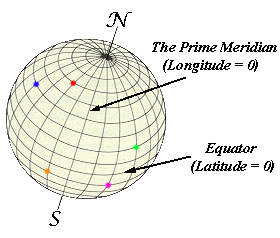
The shapes around the ‘equator’ (or great circle arc) of a sphere are larger than those found at the poles. The blocks from the “polar” area of a sphere cannot fit in the location of the “equatorial” areas, and vice-versa. This means that these blocks must be custom made and precision fit to their individual specific locations in the dome or spherical section. This creates a very large number of individual masonry shapes, and each must be made for its specific location in a structure.
In contrast, there are geometric bodies known as polyhedra, which are assembled from regular repeating unit shapes, each of which are interchangeable. Each of these polyhedron approximates a sphere, or spherical section. The regular geometric shapes which assemble into and constitute a polyhedron are triangles, squares, pentagons hexagons, and a few other polygons. It is critical to note that any polygon with more than three sides can be made into triangles. For example, a pentagon can be assembled from 5 triangles; a hexagon can be assembled from 6 triangles, etc.
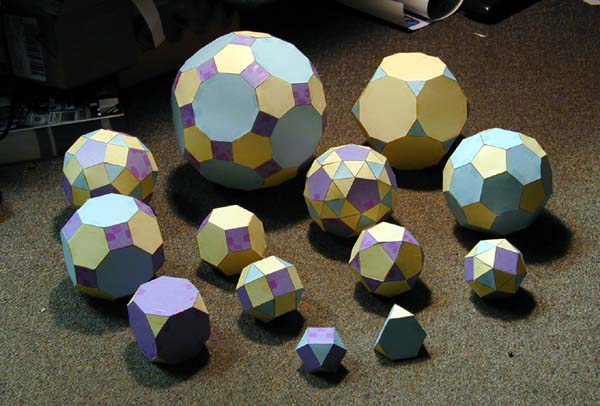
This means that all regular polyhedra can be assembled from triangular shapes. Each of these triangular shapes is interchangeable across the assembled dome or sphere. This is in direct contrast with rectangular or square shapes which lines of latitude and longitude describe on a sphere or spherical section, such as a dome. This means that the number of different shapes is reduced to a bare minimum, and that blocks are interchangeable in a structure. This feature makes for a much easier and greatly simplified method of construction.
Second, we’ll take a look at creating an interlock between blocks. The interlock provides a means of locating the block within the assembled structure: that is, the blocks are kept from sliding or otherwise moving outside the tangential surface of the shell, dome, or sphere. They are locked into radial position. In my last entry I described the importance of this interlocking feature in keeping block located within the tangential curved surface of a dome. If the block are free to slide out of the radial surface, a hinge is created, and the structure can buckle and collapse. The interlocking feature thus makes assembled domes and arches much stronger, since the block are locked into their radial position in a sphere or dome.
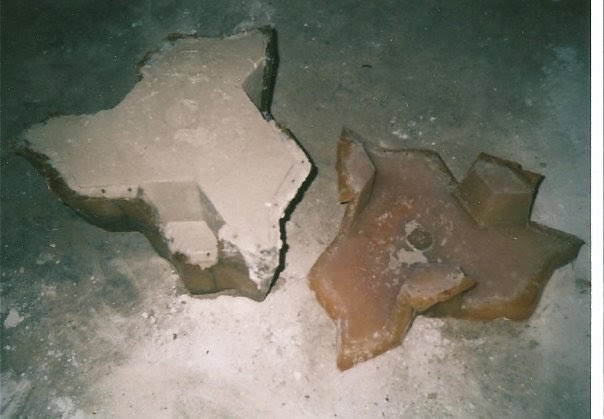
Third, these interlocking triangular block are able to be made on a two-piece mold without an undercut, or draft, or negative angle. This is critical because it allows for the masonry shapes to be inexpensively and rapidly mass-produced. If there is an undercut, or draft, or negative angle, then the unit shapes will not release from a mold: it is stuck and becomes hard to release. A draft angle (or negative angle, or undercut) greatly complicates making the shape. Sliding parts (to release a shape) and complex molds make such a shape uneconomical to produce. It is instructive to note that concrete block are manufactured in matter of mere seconds. To slow this process changes the economics of production, and the product so made is not economically viable. It is critical to provide a simple two-piece mold without any undercuts, as shown below.

Fourth –and finally- the block must be able to be assembled without any draft, or undercut, or negative angle. The masonry shapes must be able to slide into their assembled position. If the structure (dome or sphere) must be “pulled apart” to allow the interlocking feature to engage, the structure cannot be built. It is critical that there is not an undercut, or draft, or negative angle in terms of assembly. For example, the blocks I’ve developed have a half-diamond key with an obtuse angle (at the tip of the key) of 120 degrees. If the key were a half-square, with an angle of 90 degrees at the tip of the key, then there is a draft angle, or undercut, or negative angle which prevents the block from sliding together and being assembled. In the drawing below, if the blocks had square- cornered keys, they could not be assembled; it would create an undercut.

The triangular interlocking masonry system which I’ve developed represents the mathematical limit of such a shape, and it simply cannot be improved upon. If there were more of an interlock, the block would not release from a mold, and simply could not be made. If there were an undercut in terms of assembly, then no structures could be built because the blocks simply couldn’t be assembled.
This was first pointed out to me by a team of mathematicians who attended my thesis defense, when I unveiled this design as part of my fulfillment for my degree in Masonry Science at Alfred University’s New York State College of Ceramics. I am still only beginning to appreciate the significance of this mathematical proof. Within the parameters I described in this entry, it is not possible to improve on this design; it reflects a mathematical and geometric limit of design.
See about the art of limits here. later this same month.
See about the art of limits here. later this same month.

