Showing posts with label square cube law. Show all posts

Friday, January 27, 2012

Shell Theory and Masonry Domes

Shell Theory is a field of physics, mathematics, architecture, topography and engineering which provides insight into masonry dome structures.  Today I’ll be looking at Shell Theory in the context of many topics which I’ve already written about on this blog, and tying several things together toward some valuable insight into masonry dome and arch structures.
Shell Theory has its roots in the Euler–Bernoulli Beam Equation (also known as the “engineer’s beam theory”, “classical beam theory” or just “beam theory”) which was developed around 1750.  This theory describes a means of calculating the deflection and load-bearing capacity of a beam.  This theory was not fully utilized until the late nineteenth century, with the construction of both the Eiffel Tower and the Ferris Wheel.  This theory played a major role in the engineering developments of the Industrial Revolution.

The Euler-Bernoulli equation describes the relationship between applied load and deformation, where E is the elastic modulus; I is the second moment of area; w is the deflection of the beam at some point, x; and q is the distributed load.  Don’t be scared by this equation!  It says if you push a beam this hard, in that place, it will bend this much, that’s all.

Plate Theory is an expansion of beam theory to thin-walled structures, or “plates.”  The plate is assumed to be thin enough that it can be treated as a two-dimensional element, rather than as a thick beam, as in beam theory.  Plates are assumed to be flat, or planar.

If the plates (in plate theory) are curved in two dimensions, then we enter the realm of shell theory.  A round cylinder is curved in one dimension: whereas a sphere, or dome, is curved in two dimensions.  A plate bent in two dimensions will have greater flexural rigidity than a plate bent in one dimension, and be more rigid still than a flat plate.  (Flat plates are still shells; they’re just boring, weak, flat shells).

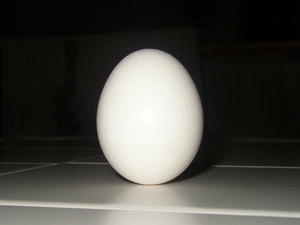
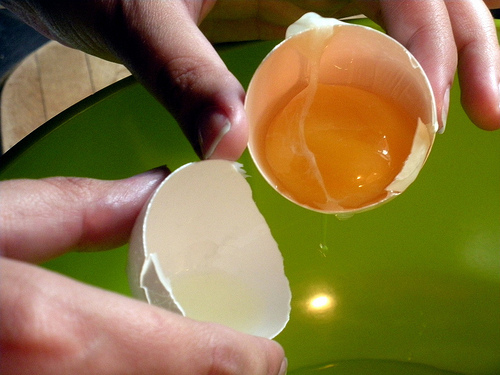
One good illustrative example of shell theory is provided by looking at an actual shell, like a chicken egg shell.  If we return to Brunelleschi, who I talked briefly about here, it is interesting to note how he convinced his patrons (Medici) to allow him to build his famous dome.  He simply took eggs and squashed their wide bottoms, so the thin tips were pointing up!  Voila! He seemed to say, the egg creates a catenary arch which is simple, robust, rigid, symmetrical and will serve as a form to make the masonry dome, or duomo.  His idea worked, it worked magnificently, and today we still have his duomo as a testament to his insight.  It is interesting to note that Brunelleschi had a highly developed intuitive sense of shell theory centuries before this theory had been mathematically expressed and articulated by equations.

If we take this example of an actual egg shell and apply some of what was learned by Galileo’s mistake of applying his Square Cube Law to masonry structures (as I discussed here, here and here) the results are pretty astounding.  The reader will recall that one critical fact of masonry arches is that they are scaleable.  This means that if an arch’s span is doubled, it will remain stable so long as the wall thickness is also doubled.  As long as proportions remain intact, a dome or arch remains stable, no matter how large it is made.  This is a direct refutation of Galileo’s Square Cube Law.  Galileo was wrong when he applied his law to masonry arches.

An actual chicken egg has a ratio of wall thickness to diameter of 7 to 1000.  In other words, an egg 2 inches across has a shell which is 0.014 inches thick.  If we “scale up” the egg so that it has a diameter of, say, 25 feet in diameter, then the walls would be only 0.175 inches thick!  This points to the inherent strength of a masonry arch which is doubly curved, or domed.  Any engineer must include a safety factor.   I am planning to make triangular block to build a 25 foot diameter dome with wall thickness of just 4 inches.  If directly compared with an egg shell, this provides an adequate safety factor of almost 23 (0.175 x safety factor = 4; safety factor = 22.857).  A typical safety factor is usually around 10.  Thus a 25 foot diameter dome made with block 4 inches thick would have a very high safety factor.  Of course block differ from eggshell, so the comparison is tricky; more on that later.

I’ll talk more about Shell Theory and masonry domes in my next entry.  This is a fascinating topic.

Wednesday, July 21, 2010

Lessons learned from Galileo's mistake

For the past two entries on this blog, I looked at Galileo’s valuable insight known to us today as the Square Cube Law. Galileo made the mistake of applying the Square Cube Law to masonry arches. He said (p.33) “The great Master Builders of the past used proportional design rules, which are essentially incorrect. Using these rules they built masterpieces of architecture and engineering of the past.” But it was Galileo who was essentially incorrect.


As we wrap up our discussion of Galileo’s incorrect application of the Square Cube Law, a few things stand out from the insight gained by a correct analysis of arches, stresses, and load-bearing ability.

First, the important concept of a catenary is made even more emphatic, and trumps the role of the Square Cube Law. As discussed earlier, a catenary comes from the Latin word “catena” which means chain. Architects also use the term “funicular” to describe the catenary curve; from the Latin “funis” meaning rope or cable. When speaking of masonry, “catenary” is actually a more accurate term, because a masonry arch is comprised of voussoirs, or individual masonry blocks, which are analogous to the individual links of a chain; not the smooth continuity of a rope or cable.

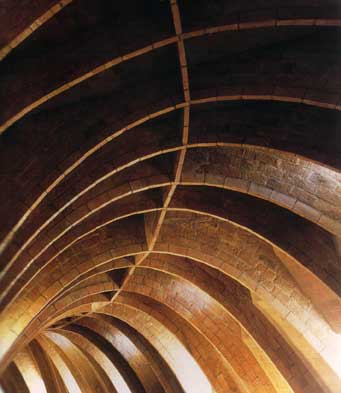
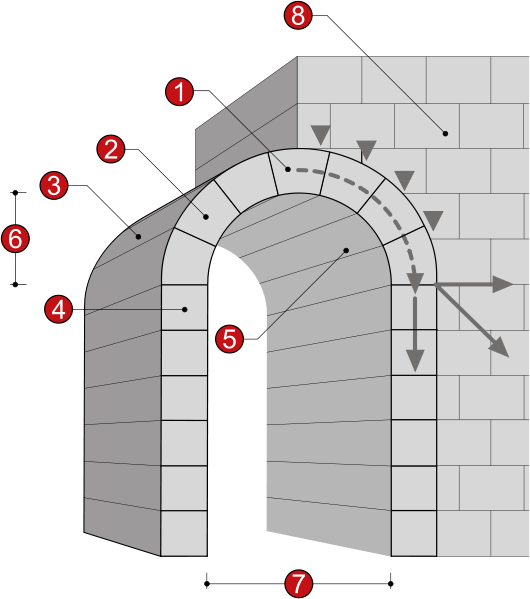
In every arch which is built and stays standing, there can be traced a catenary curve within the wall thickness, described by the thrust force lines which represent the force of gravity acting on the voussoirs. If this catenary curve goes outside of the wall thickness, then a hinge is created, the arch will buckle at this hinge, and it will collapse.

As long as the catenary curve fits within the wall thickness, walls can be made thinner and thinner. Furthermore, the addition of loads onto a masonry arch tends to keep the thrust force lines within the wall thickness: so that adding weight can actually strengthen a masonry arch or dome.

This is the essential design analysis for masonry arches and domes. It really has nothing to do with Galileo’s Square Cube Law. Whether by conscious design and intuitive insight, or merely by trial and error, the master masons of antiquity always fit the catenary curve within their wall thickness by using their simple rules of geometric proportion; this is why their structures could be made small or large, and this is why their incredible feats of engineering and art still stand today to inspire us and enrich us.

Monday, July 19, 2010

Master Masons: Smarter than Galileo?

I recently read a fascinating article by Santiago Huerta, a Spanish architect whose expertise lies in the structural analysis of arches and domes. (Galileo was Wrong! the Geometrical Design of Masonry Arches, Nexus Network Journal, Volume 8, No. 2, 2006).


Mr. Huerta describes how since antiquity, master masons have always used simple geometric rules involving proportions to design arches. For example, if an arch is a certain length (or span) it must be a certain thickness. It is a proportional design independent of scale. This method was developed before (and independent of) any formal scientific method. This system employed by ancient master masons has proven very effective, as demonstrated by the existence of numerous large masonry structures which have survived over millennia, as discussed several times earlier on this blog.

The proportional approach is a geometric approach: designs are scale able, an arch design which is 10 ft wide and one foot thick can also be made 30 feet wide and 3 feet thick. This approach was used for hundreds (even thousands) of years before it was questioned by Galileo.

In 1638 Galileo attacked this simple approach used by master masons in his work Discorsi e Dimostrazioni Matematiche intorno à due nuove sicenze Attenenti alla Mecanica & i movimenti Locali (Dialogues Concerning Two New Sciences). Here, for the first time, was an articulation of what has come to be known as the Square Cube Law.

Here is Galileo attacking the method of proportions in rumination on his research to his colleague, Giovanni Francesco Sagredo:   “Therefore, Sagredo, you would do well to change the opinion which you, and perhaps also many other students of mechanics, have entertained concerning the ability of machines and structures to resist external disturbances, thinking that when they are built of the same material and maintain the same ratio between parts, they are able equally, or rather proportionally, to resist or yield to such external disturbances and blows. For we can demonstrate by geometry that the large machine is not proportionally stronger that the small. Finally we may say that, for every machine and structure, whether artificial or natural, there is set a necessary limit beyond which neither art nor nature can pass; it is here understood, of course, that the material is the same and the proportion preserved.”

Galileo was formally developing the notion that as a size increases, its surface area increases as a square, and its volume increases as a cube. He took these simple facts and applied them to design of structures. This same principal is evident in nature: the bone structure of a bird is not proportionally the same as that of an elephant. The elephant’s bones are much more massive than that of a bird; because the increase in scale is not linear, the volume is cubed.  This can be extrapolated out to the scale of a dinosaur.


This all relates directly to masonry and scaling of structures. I will continue this discussion next time, and we will see that ultimately Galileo was wrong, and that the “ignorant” master masons of antiquity had it right.