Showing posts with label spheres. Show all posts

Tuesday, September 17, 2013

Spherical Tanks: Better than Cylinders


Storage tanks are used for a large number of applications and for storing various materials.  Tanks can be used to store water, oil, fracking chemicals, toxic material and so forth.  The most typical configuration for a storage tank is a cylinder, with a flat bottom, and vertical cylindrical walls.  This cylindrical design is not the most stable, but is susceptible to flooding, erosion, and subsequent spillage.

Recent flooding in Colorado has shown that cylindrical storage tanks are not stable, but are vulnerable to flooding, erosion, toppling and failure.
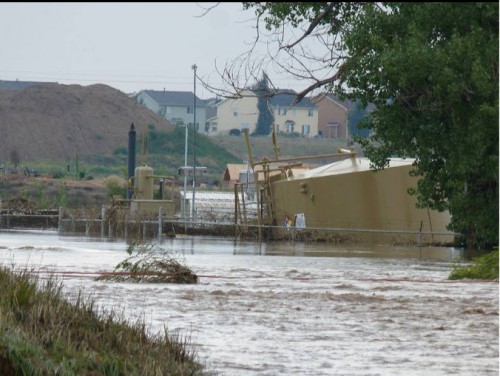
By contrast, a spherical tank is much more stable.  A sphere does not have a top or bottom: it is round and inherently much more stable than a cylinder.  A sphere is not susceptible to erosion, toppling, asymmetry, leaning or collapse in the same way a cylindrical tank is.  A sphere cannot be knocked over on its side, because it is round.   A high-strength spherical tank made from interlocking triangular concrete block woven together with steel cable or rebar is vastly superior to conventional cylindrical tanks.


This obvious feature of spherical geometry is so simple as to be self-evident and would seem hardly worth pointing out.  However, since cylindrical tanks are failing, and have failed, and are likely to continue to fail, it is worth showing here that a spherical storage tank is much more stable, inexpensive, easier to assemble, more efficient and far safer than the conventional cylindrical tanks used (especially by the oil and gas and fracking industries) which have shown their instability and poor performance recently in Colorado.


While the recent flooding in Colorado is described as a 500 or 1,000 year event, it may cause people to think:  “This won’t happen again for a long time, we won’t have to worry about this sort of event for hundreds of years.”  This attitude neglects the danger posed by storm surges along coastal areas during hurricanes, and also neglects our changing climate which is prone to additional flooding across the country and around the world.   For example, all the radioactive toxic water stored at Fukushima is stored in cylindrical tanks: at the very location where a tsunami could strike again, any time.
 

Spherical tanks are inherently more stable, safe and better than cylindrical tanks.  It is obvious and self-evident as recently demonstrated in Colorado.
 

Saturday, January 19, 2013

Topological interlocking structures

I recently came across an interesting paper done by a team of physicists and mathematicians titled The Concept of Topological Interlocking in Engineering  by AV Dyskin, Y Estrin, E. Pasternak, HC Khor andAJ Kanel-Belov of the Department of Civil Resource Engineering, the University of Western Australia, Australia; Institut fur Werkstoffkunde und Werkstofftechnik, Technische UniversitatClausthatl, Germany; and Unversity of Bremen, Germany (Materials Science and Engineering, Volume 31, Issue 6,August 12, 2011, pp.1189-1194).

The work described in this paper by this team is very similar to some of the work I have been conducting over the past 20 years or so.  First, they identify their inspiration as occurring in the biology of nature, as I have also done (see “Nature’s Masons” on this blog). 

Secondly, they describe how a structure assembled from their interlocking units is toughened, as it is resistant to crack propagation between adjacent interlocking units (as I have also described several times on this blog, e.g. “Harder, stronger, stiffer, tougher”). 

Third, they provide a rounded edge to their interlocking shapes, so as not to focus stress, as I have also described on this blog (see “The art of limits (and the limits of art”).
 

The authors point to the failure of thermal tiles on thespace shuttle Columbia as one example of how their concept of “topological interlocking” can be advantageous by providing a toughened structure held together by geometry alone; which is at the very heart of my own work.  The authors' system is comprised of parts interlocked with the concave features of one block interlocking with convex parts of another block, and vice-versa.  This is precisely how my dual-inverse mirror plane (dimp) arrangement works also. 

They assembled flat (planar) sections of structure using various polyhedral arrangements and tested these for strength.  They found that the resulting planar configurations could withstand significant stress tests, and furthermore that loss of one or more interlocking block did not necessarily result in failure of the structure.  Again, this is what I have been saying about my own system for years.

The work of this team is very interesting, and validates and substantiates much of what I have been saying for years.  Their system does lack a few of the advantages to be found in the designs I have developed.  First, their topological interlocking units create an undercut, or draft, or negative angle which cannot be readily released from a simple two-piece mold (unlike my system).  Secondly, their system is not capable of conjugate shearing in the same ease of manner which triangular shapes inherently allow.  Third, they build flat planar structures, and their system does not allow for a radial (spherical and cylindrical) structure as readily, as easily and as strongly as my system does (my system can also do flat planar structures).
 

I was delighted to see this work and realize that other teams of engineers share the same insight into the advantages inherent in a system comprised of interlocking unit shapes.

Friday, May 7, 2010

Glass Block: a new design

The block system described in this blog readily lends itself to being made with glass. Today we’ll take a look at glass block, and how it would be suitable for this masonry system.


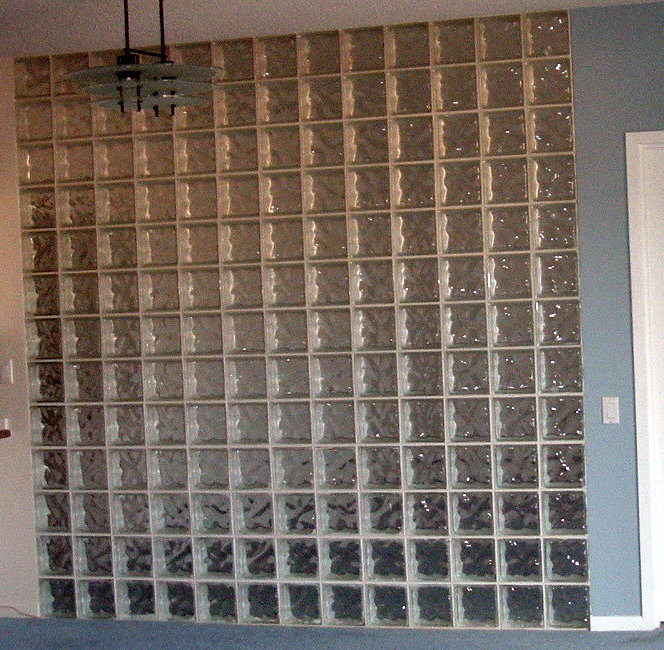
Glass block has become a fairly widespread construction material. As with concrete block, glass block are currently limited to square and rectangular blocks. This limits the architectural applications of glass block to straight vertical walls and square corners. Some block designs include curved corners, but currently no glass block can be used for spherical or dome sections, as I’m proposing here. It’s interesting to me how regular glass block today says “1980’s” and is not considered current, or ‘in vogue.’

Glass block is manufactured by first forming two pieces of glass, and then joining them while the glass is still warm enough to be moveable (at around 800 degrees F). The two pieces are pinched together in a two-piece mold and allowed to anneal, or cool slowly to reduce thermal stresses and obtain a thermally stable object. If the hot glass is not properly annealed, it will crack some time after it is removed from heat.

Hollow glass block creates a decent thermal insulator, and saves heating and cooling requirements for a given building.

Interestingly (perhaps counter-intuitively) glass has a high strength: higher than concrete in some cases. The theoretical strength of glass is very high, and is only reduced by small surface flaws which create starting points for cracks to begin and significantly lowers the actual strength of glass.

Glass can be greatly strengthened by using a technique called ‘ion substitution.’ Glass typically is made with a flux agent, which lowers the melting temperature of the glass. Sodium is a common flux, and is typically found in silicate glasses. If a sodium silicate glass is immersed in a heated bath, comprised of (for example) potassium compounds (e.g. KOH), then the potassium will migrate into the glass, and replace sodium. Potassium is larger (ionic radius) than sodium, so it ‘stuffs’ the glass and creates compression in the glass; resulting in a much stronger glass. This method could be used to create very high strength architectural glass block.

The block system I’ve been describing in this blog is made on a two-piece mold, without any undercut. This is what is required to make hollow glass block. The block system I’ve been describing is appropriate and suitable for producing hollow architectural block.

The glass block produced from this masonry system can be used to assemble spheres, domes, arches, straight walls, and various combinations of these architectural elements. These blocks will all interlock, they are disposed to conjugate shearing without breaking, they can use a series of tensile elements (e.g., steel cable, Kevlar, etc.) to provide a much higher strength to the entire structure.

Glass block can also be used together with concrete block. This is important because glass block is more expensive than concrete, so it can be used as a highlight feature, and bring some dramatic lighting elements to an overall structure. Glass block can also be used to build a small dome, which could be incorporated as a cupola, or an architectural feature within a building. Imagine a glass dome at the top of a foyer or entryway into a building or house.

The symmetry and hexagonal elements inherent to this masonry system produces a ‘snowflake’ effect, where the architecture has a close resemblance to the beauty and symmetry found in snowflakes.